

Making cloud footprint easier to understand
Cloud infrastructure is often evaluated through the lenses of performance, cost and scale. Increasingly, however, teams are also asking a different question: what is the operational footprint of the services they run?
To make that easier to understand in practice, WAYSCloud is introducing Climate Insights — a platform module that estimates energy use, CO₂e and efficiency signals across WAYSCloud services using usage data, regional grid intensity and service-specific models.
Climate Insights is available in the WAYSCloud customer portal and included with the platform at no additional cost.
The module reflects a broader WAYSCloud principle: infrastructure should be easier to understand, not harder to interpret.
A consolidated view across services
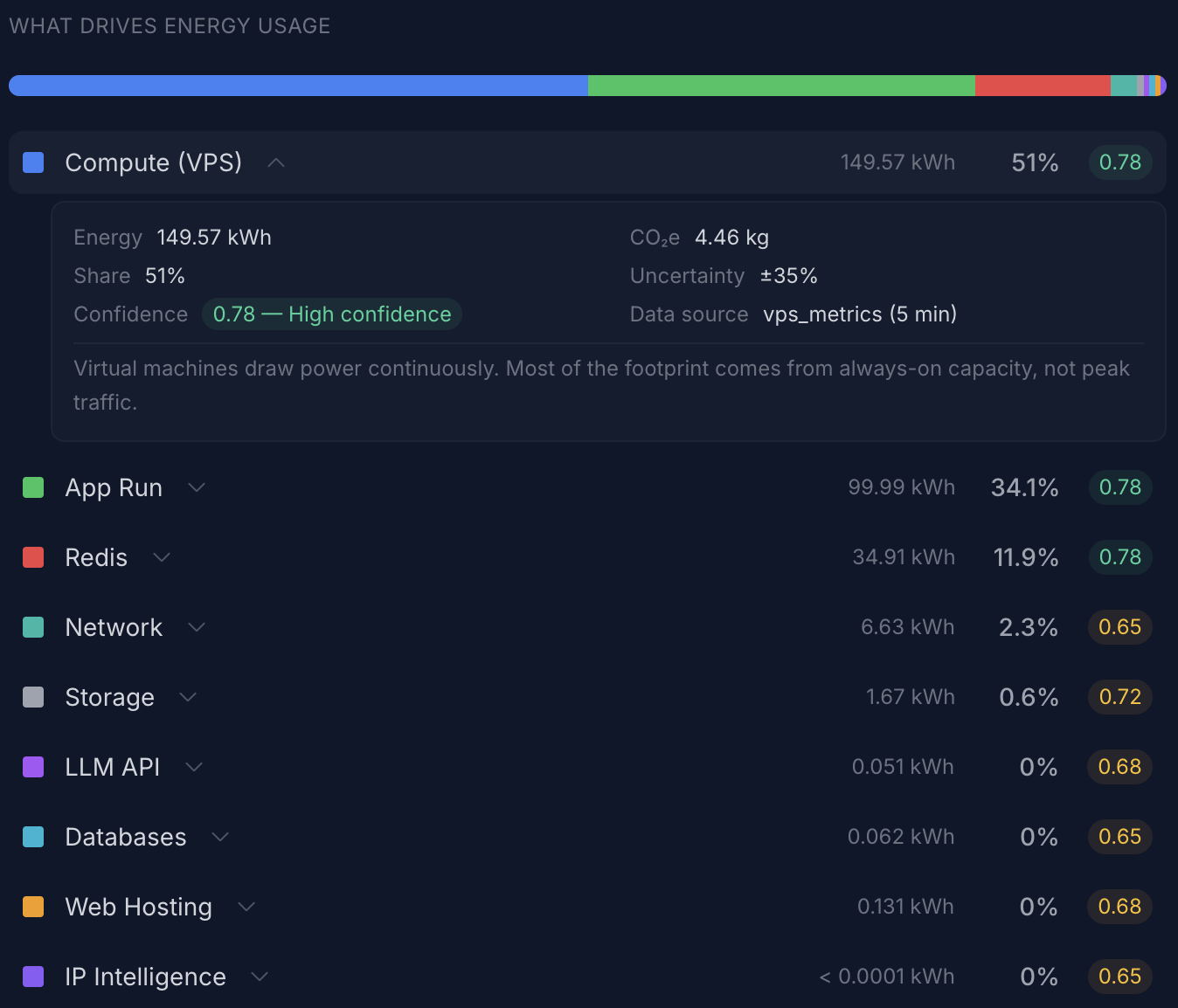
Climate Insights gives customers a consolidated view of estimated footprint across service categories such as compute, databases, storage, app platform, DNS and other supported components.
Rather than presenting a single opaque figure, the module is designed to show what is being estimated, how those estimates are derived, and where optimization opportunities may exist.
Built for visibility, not vague sustainability claims
Environmental visibility in cloud environments is rarely straightforward. Some signals can be inferred from telemetry and measured usage, while others depend on modeled conversion factors and service-specific assumptions.
Climate Insights is designed around that reality. It is intended for operational visibility, trend analysis and practical optimization — not as audited carbon accounting.
In practice, the module helps customers understand which services drive footprint, how estimates are formed, and where infrastructure can potentially be made more efficient over time.
“Climate Insights reflects a broader principle at WAYSCloud: infrastructure should not become more opaque as it becomes more capable. Customers should be able to understand the operational signals behind the services they run — including energy use, efficiency and estimated footprint.” — Knut Michael Haugland, CEO of WAYSCloud
Turning estimates into practical action
Climate Insights is not limited to reporting. It is designed to make environmental signals operationally useful.
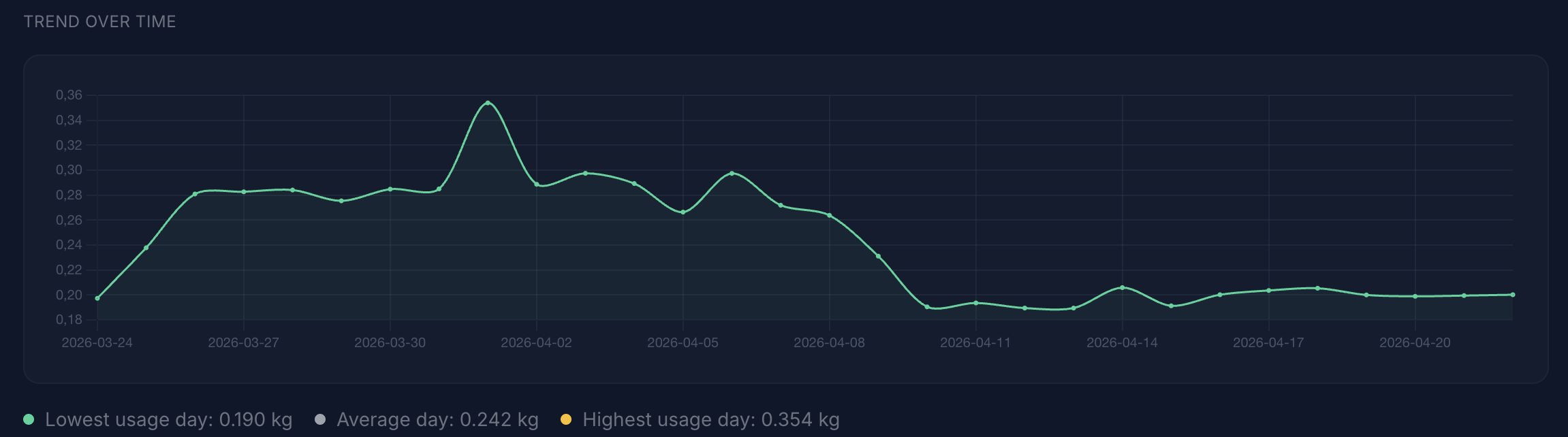
Customers can use the module to review estimated energy use and CO₂e by service category, compare trends over time, and identify optimization opportunities based on usage patterns and idle resources.
Typical opportunities may include scaling down underused compute, reviewing low-activity services, reducing unnecessary storage overhead, or cleaning up unused DNS zones and other dormant resources.
That makes the module relevant not only for sustainability visibility, but also for infrastructure hygiene and day-to-day platform optimization.
Scope, methodology and limitations
Climate Insights is informed by established external guidance and internal modeling. Relevant reference points include the Green Software Foundation SCI methodology, Cloud Carbon Footprint methodology and GHG Protocol Scope 2 guidance.
The model currently focuses on Scope 2 operational energy only, using location-based accounting.
Confidence scores indicate how reliable each estimate is based on the available data. Higher confidence generally reflects more direct measurements and fewer assumptions. Overall confidence is weighted by energy contribution across services.
The module is also explicit about its limitations. It does not include embodied carbon or broader Scope 3 factors, does not account for renewable energy instruments such as RECs or Guarantees of Origin, and in some areas relies on industry-standard estimates rather than direct datacenter metering.
Examples include estimated PUE values, CPU power derived from utilization proxies, network energy modeled from transfer averages, and shared hosting estimates based on fractional infrastructure usage. Certain external or negligible services are also excluded.
For that reason, Climate Insights is intended for comparison, optimization and trend analysis over time — not for audited carbon reporting.
Region matters
Because electricity mix differs significantly between regions, Climate Insights also reflects the effect of local grid intensity in supported geographies. This helps place estimated footprint in a more realistic operational context.
Recent reference values include approximately 15–19 gCO₂/kWh in Norway, 41 in Sweden, 56 in France and 361 in Germany, compared with broader reference levels such as 213 across the EU and 384 in the US.
Available in the customer portal
Climate Insights is available directly in the WAYSCloud customer portal.
The module is available automatically for supported services and does not require separate activation. Additional documentation is available in the Climate Insights service documentation.
The trend view is designed to make change visible in practice. Customers can see how estimated footprint develops over time, making it easier to spot both positive improvements and negative drift before inefficiencies become harder to unwind.
Designed to improve over time
Climate Insights is designed as an evolving platform capability rather than a fixed reporting layer.
Future improvements will focus on broader service coverage, increased use of direct telemetry, refined conversion models and more granular optimization signals across the platform.
As the model matures, WAYSCloud expects Climate Insights to provide stronger historical comparisons, better service-level explainability and increasingly useful efficiency recommendations — while remaining transparent about methodology, assumptions and uncertainty.
Part of a broader platform philosophy
At WAYSCloud, Climate Insights reflects a broader product philosophy: cloud services should not only be available and scalable, but also measurable, understandable and easier to improve.
The goal is to make environmental signals more visible and useful in practice, while continuing to strengthen precision, coverage and explainability over time.