

Most companies have a status page.
It shows whether services are up, degraded or unavailable. It answers a simple question: what is happening right now?
But it does not answer the more important question — what actually happened.
In cloud infrastructure, there is a layer of reality that rarely becomes visible. Not because it is insignificant, but because it is difficult to explain, easy to misinterpret and often uncomfortable to expose.
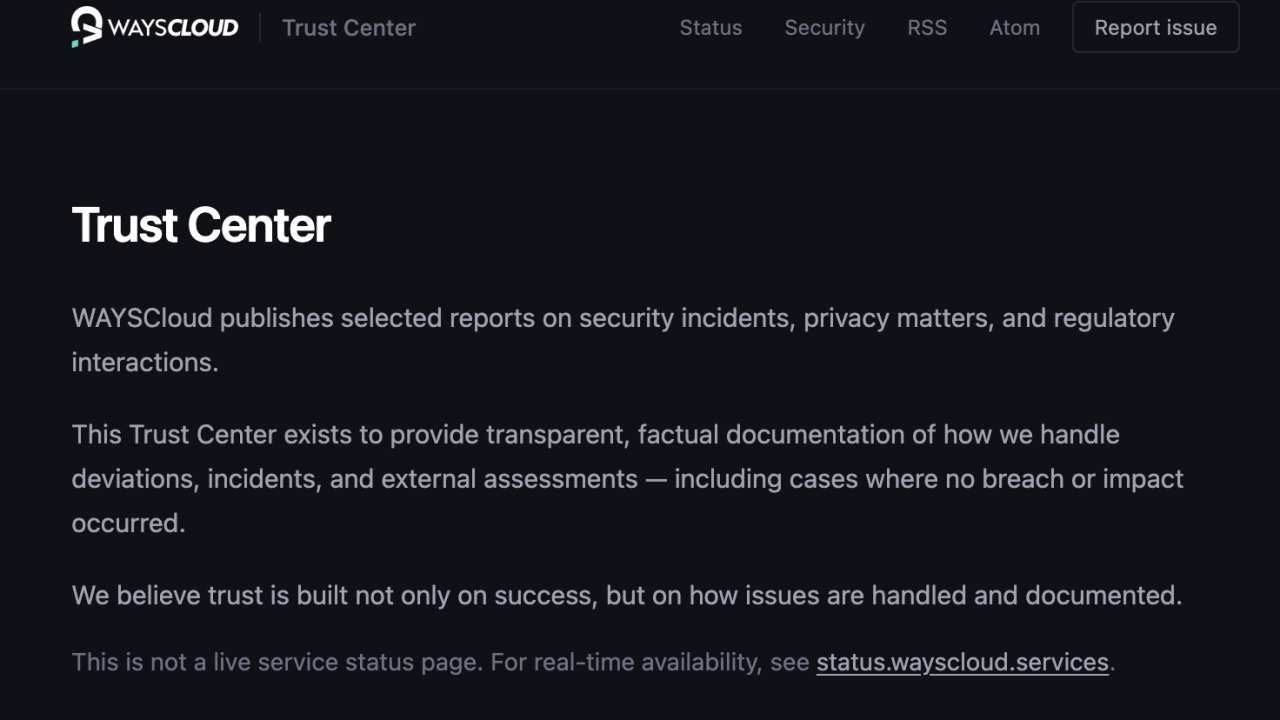
At WAYSCloud, we decided to create a place for exactly this layer.
We call it the Trust Center.
“Transparency should not start where things are comfortable to explain. It should start where accountability is required.”
Knut Michael Haugland
CEO, WAYSCloud
Beyond status pages
The Trust Center is not a marketing page or a curated highlight reel. It is a structured, public record of selected cases related to security, privacy, operational deviations and regulatory interactions.
This includes cases where the outcome is “nothing actually happened” — because that is also part of reality.
It reflects how systems behave in practice, not just how they are expected to behave.
Transparency as a discipline
Most incidents never become public. Not because companies are dishonest, but because there is no natural place to put them.
Status pages are real-time. Blogs are curated. Internal reports stay internal.
So the details disappear.
The Trust Center is designed to change that.
We document:
what initially looked serious, but wasn’t
what required investigation or external review
what we got wrong internally
what changed as a result
Not just the clean version.
Control, not exposure
Transparency does not mean exposing everything.
Sensitive data must be protected. Context must be preserved. And not all details can or should be public.
But within those boundaries, more can be shared than is currently the norm.
Trust is built over time
Trust in infrastructure is not built on the assumption that nothing ever goes wrong.
It is built on how complexity is handled, how decisions are made, and whether there is a willingness to document what actually happened afterwards.
If everything always looks perfect, it usually isn’t.
The Trust Center is our way of making that process visible.
Trust is not built by hiding complexity — it is built by showing how you handle it.